
Caran d'Ache Museum Aqaurelle And Holbein Artist Watercolor Pencils Comparison
Caran d'Ache Museum Aqaurelle And Holbein Artist Watercolor Pencils Comparison
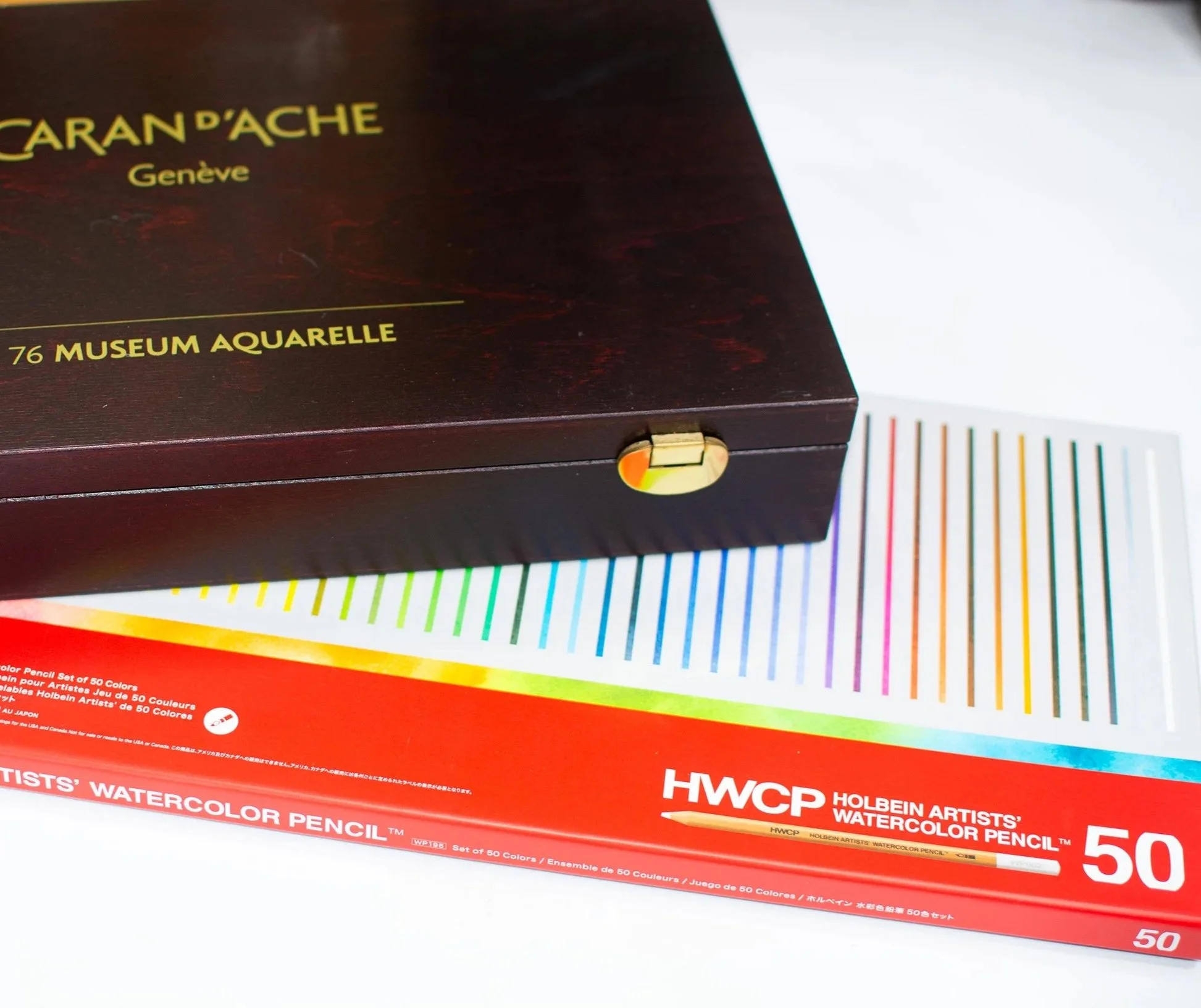
September 2025 seen the official launch of the much sought after Holbein Watercolor Pencils in Japan, however it wasn’t until early 2026 that countries further afield only started gaining access to them. Here on The Art Gear Guide and Ann Kullberg’s Color Magazine, we managed to issue our review late 2025 and early 2026. That being said, once I completed my testing and demonstrating of the Holbein Artist Watercolor Pencils, I quickly moved on to my comparison ideas, the first of which was of course the comparison you are reading now, the Caran d’Ache Museum Aquarelle Watercolor Pencils against the Holbein Artist Watercolor Pencils.
I will of course be adding more comparisons featuring the Holbein Watercolor Pencils, but there was no question that the Caran d’Ache Museum Aquarelle had to be first in the firing line, after all, they have been widely considered the best water soluble pencils on the market.
Characteristic Differences Between Holbein and Caran d’Ache Museum Aquarelle Watercolor Pencils.
The Caran d’Ache Museum Aquarelle and Holbein Watercolor pencils are similar aesthetically speaking, both pencils sporting hexagonal barrels with the Holbein barrel weighing in at 7.4mm and the Caran d’Ache barrel slightly bigger at 7.6mm. The cores of both pencils are approximately 4.1mm, a hugely generous core given the quality of pigments held within each core.
The barrel of the Holbein pencils are finished in a wood grain finish, varnished with a gloss appearance and a one inch pigment identifier on the end of the barrel. The Museum Aquarelle barrel is lacquered in a matter of black, followed by an inch and a quarter pigment identifier on the very end of the barrel. Both barrels make pigment identification quick and easy.
Both pencils sport the lightfast information on the barrel in the format of stars, as well as both pencils displaying the pigment name and number printed. Finally both pencils sport the respective company names printed along the barrel, along with the pencil model and of course the paint brush icon, depicting water soluble supplies.
Performance Differences Between Holbein and Caran d’Ache Museum Aquarelle Watercolor Pencils.
This is where the important information is discussed but I think watching the YouTube video comparison will also go a long way to helping you understand the nuances between both pencils. First of all from the swatches produced, in their dry state I think both pencils look very similar, although the Holbein Watercolor Pencil core certainly felt harder than that of the Museum Aquarelle.
The activated swatches provide a very different result, here you can see that the Holbein Watercolor Pencils are much more translucent and the Museum Aquarelle are more saturated. This is not necessarily a good or bad thing, as artists we all have our own preferences and some watercolor artists prefer more translucent paints over more opaque.
Comparison Artwork
I wanted to create artwork using both the pencils and in order to maintain an identical image for both demonstrations, I drew some peppers and then traced the original image, placing both images next to each other. I thought adding a red, green and yellow pepper would go a long way to helping understand the saturation differences between both pencils etc. It is important to note, the artwork is not really the subject matter for this situation, it is more the application of pigment and layering abilities etc.
I started with the Museum Aquarelle pencils; I did try to select the same or similar colors from each set to make the demonstration as fair as possible, but with the Caran d’Ache Museum Aquarelle coming in a count of 76 and the Holbein Artist Watercolor Pencils only sporting a set of 50, the color selection was a little more favourable for the Museum Aquarelle.
Caran d’Ache Museum Aquarelle Artwork Format
I applied the pencil in its dry format, in the same manner you would with traditional colored pencil art, once I had completed the first layer on all three papers, I then activated the pigment with water and this is always when the real magic happens. Once the first layers had time to dry, I applied a second coverage only this time I used the Caran d’Ache Palette to mix the pencils on. This method allows for more accurate color mixing and finding the right tones for shadow areas etc. Finally once this second layer had dried, I then applied a third layer but only activating smaller areas with water, leaving some of the dry pencil for texture.
When applying the various layers directly to the paper, I definitely felt I didn’t need to apply as much pressure to the pencils, light applications of the Museum Aquarelle were more than enough and once contact with water occurred the saturation levels were spectacular. I found this to be the same when using the plastic palette, lightly scribbling on the palette produced a good strong level of watercolor paint.
Holbein Artist Watercolor Pencils Artwork Format.
Completing the exact same artwork using the Holbein Watercolor Pencils was conducted in exactly the same format. I applied a dray layer to all peppers and then applied water using a watercolor brush. As was the case in the swatch, once the Holbein pencils were activated, the coverage looked more translucent; some might say washed out.
The core of the Holbein Watercolor Pencils definitely felt harder than the Museum Aquarelle and I did encounter a small issue with the Holbein pencils when it came to using the Caran d’Ache Palette. To really get a good understanding of this issue, I have added a real time demonstration on the YouTube video review. Simply put, when applying the Holbein core to the palette there was a significant amount of crumbs left, which is normally not a problem as it all dissolves into paint when water touches it.
However, with the Holbein core, there was a large amount of crumbs that simply would not dissolve in the water. On the video you can clearly see flakes of crumbled core that just won’t dissolve and I am not 100% sure as to the reason for this.
With regards to which artwork looks the best, that unfortunately is a completely personal thing. I personally think the red pepper on the Museum Aquarelle Pepper looks better, richer and the shadows look darker. If you look the Holbein Watercolor swatch there just aren’t many dark reds. However, the green and yellow peppers on both pieces look very similar, there really isn’t much standout differences between them.
Realtime Testing
Showing the artwork is one thing, but I also wanted to show the paint being activated in real time, from dry to wet. Rather than activate every single color from both sets, I selected a small group of colors from each set, the plan was to use colors from both sets that were similar, even though the pigment names are different, the colors look similar.
In this test you get to see how easily the pigment activates to paint from its dry format and ensuring that all residue from the pencil strokes are removed. As you can see, on the Holbein side of the test, the Vermillion shows clear signs of the dry pencil coverage, not at all a terribly good look when using water soluble pencils.
Lines In The Dry Application
This was something I noticed when applying the Holbein Watercolor Pencils in their dry format and although I tested the pencils on different papers, to see if the surface was the issue, the issue persisted on every surface. I must admit this is a very very small issue and one that may not impact the artistic process in anyway, nevertheless, it is something I noticed and so had to showcase it in this comparison.
When applying a few layers of the Holbein Watercolor Pencils in their dry format, there are very thin lines within the coverage. What I think is happening, due to the crumbling of the Holbein pencils and as discussed, some of the flakes are quite hard, I think the core is catching crumbles and scratching lines onto the surface with the pressure. As they are water soluble pencils, these lines completely disappear when activated with water, but as I mentioned, it was part of the findings from my testing and so I had to include it.
Set Sizes and Prices
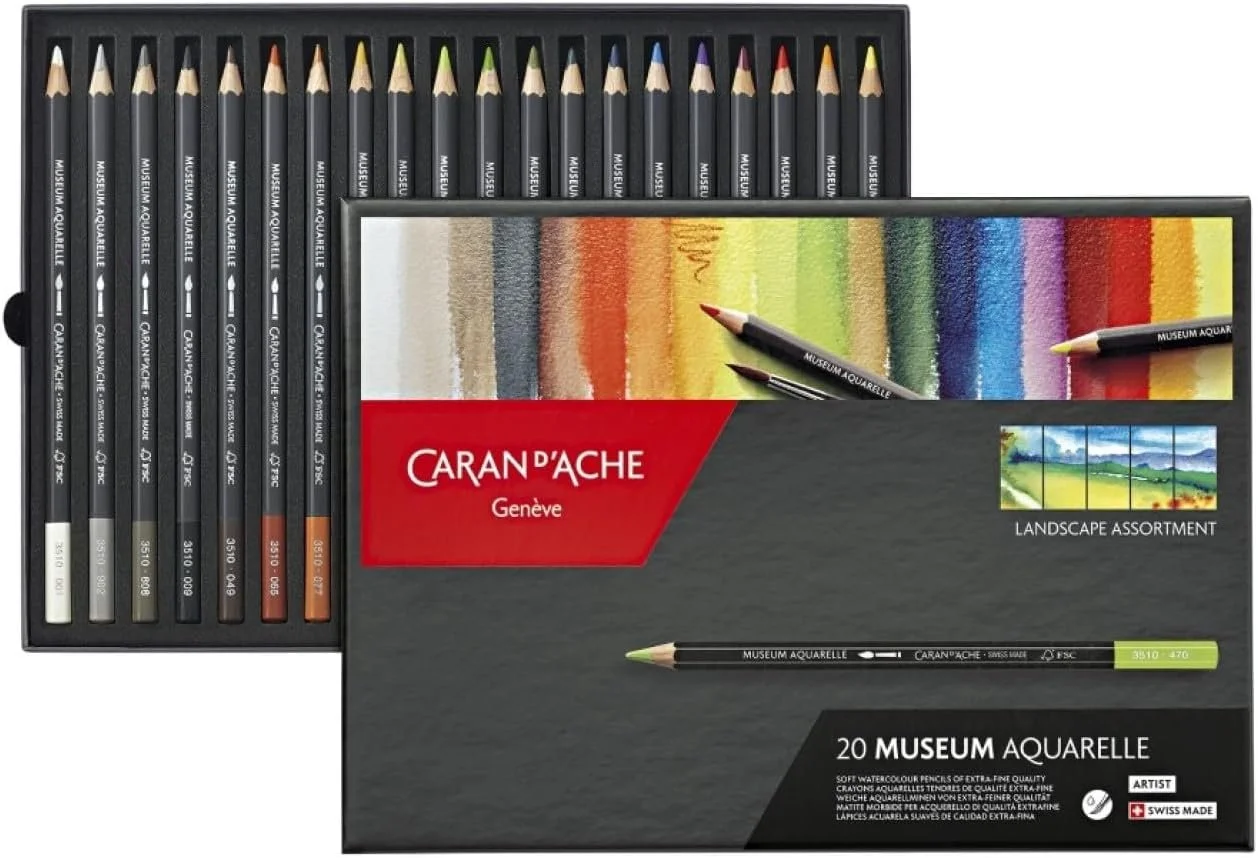
The Holbein Artist Watercolor Pencils only come in a set of 24 and 50, whereas the Caran d’Ache Museum Aquarelle are available in the following sets, 12, 40 and 76; Caran d’Ache also offer a Landscape 20 set and a Seascape 20 set. Also, both the Holbein and the Caran d’Ache Museum Aquarelle provide their pencils in open stock format.
Here in the UK, Jacksons is the main supplier of Holbein pencils and they sell the 24 set for £61, the 50 set for £126 and the single Holbein Watercolor Pencils is £2.60.
For the Caran d’Ache Museum Aquarelle pricing the set of 12 is £40, the 40 set is £149, both the Landscape and Seascape 20 sets are £67, the 76 set is £290 and finally the single Caran d’Ache Museum Aquarelle is £3.80
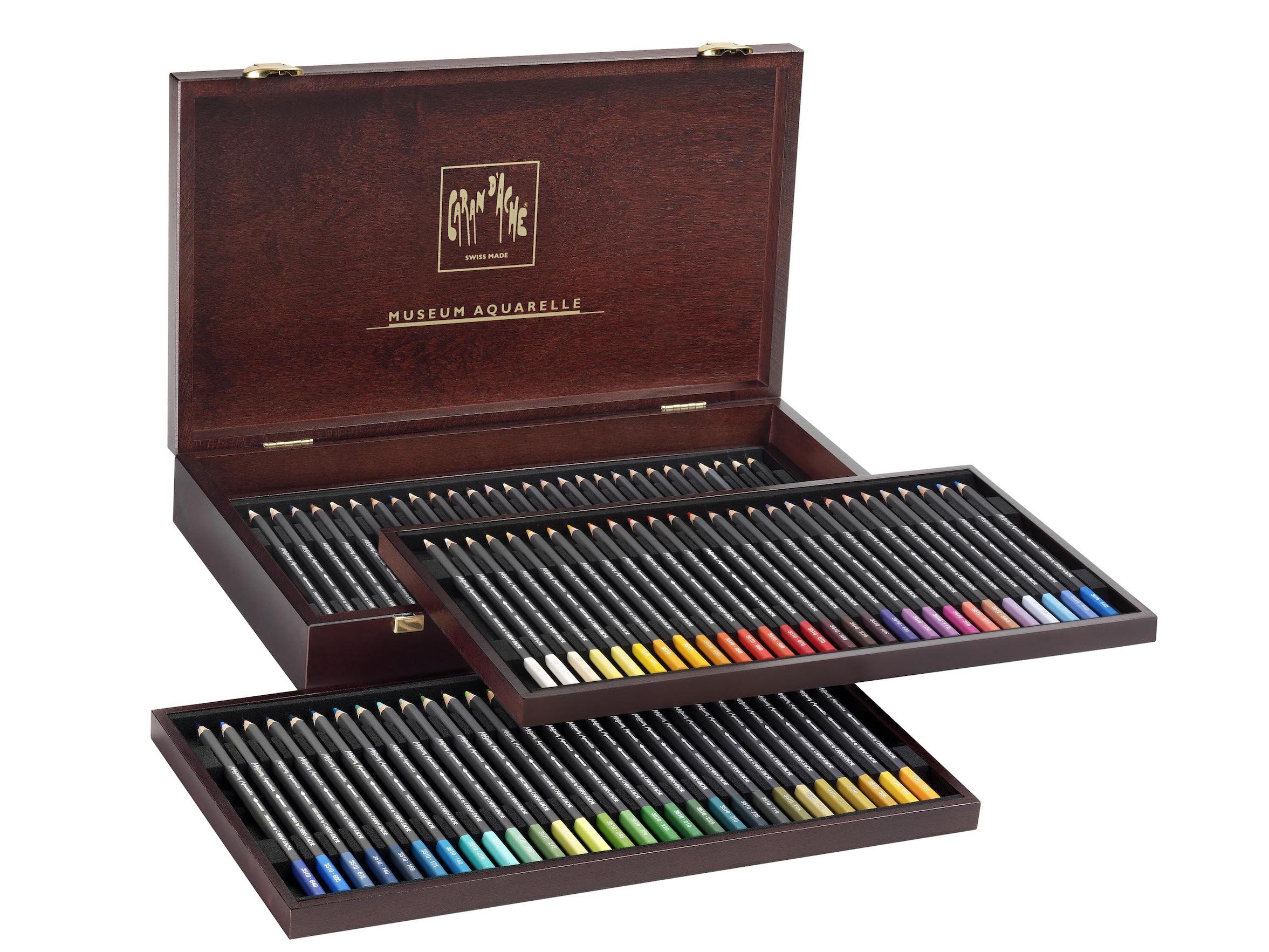
On the prices laid out above, all from Jacksons here in the UK, the Caran d’Ache Museum Aquarelle are certainly quite a bit more expensive.
Lightfast Information
Comparing lightfast ratings is again quite difficult. so I will just lay out the ratings below, however, before you check through the ratings, don’t hang all your hopes and dreams on the lightfast information. Lightfastness is not the be all and end all of creating art, there are many other ways of protecting your art from UV rays and whilst using highly lightfast products if you want to sell the original piece, as I mentioned, there are other ways around such issues.
The Holbein Watercolor Pencils are rated using the ASTM System LF1 being the most lightfast and LF5 the least. However this is represented using a star system on the pencil barrels. Of the total 50 count, 4 pencils are rated LF1 displayed as 4 stars, 16 pencils are rated LF2 displayed as 3 stars, 20 pencils are rated LF3 displayed as 2 stars and finally 10 pencils rated LF4 displayed as 1 star. I know it is a bit confusing but there is a more detailed explanation in the original Holbein Watercolor Review.
The Caran d’Ache Museum Aquarelle are rated using a star system, 60 pencils are rated LF1 displayed as 5 stars, 10 pencils are rated LF2 displayed as 4 stars, 5 pencils are rated LF3 displayed as 3 stars and finally 1 pencil rated LF4 displayed as 2 stars.
Conclusion to the Holbein Artist Watercolor Pencils and Caran d’Ache Museum Aquarelle Watercolor Pencils Comparison
There is no doubting it, both the Holbein and the Caran d’Ache Museum Aquarelle are excellent quality water soluble pencils, so much of this comparison really boils down to the type of watercolor artist you are. If you prefer more translucent watercolors then the Holbein are perfect, if you prefer more saturated watercolors then the Museum Aquarelle are your pencil.
However there are some facts you can’t get away from and that is the core hardness of the Holbein in comparison to the Museum Aquarelle, the Museum Aquarelle is a much softer core and more pigmented, meaning artists with arthritis in there hands or wrists would benefit more from the Caran d’Ache over the harder Holbein.
Some artists don’t see the point in watercolor pencils, they are of the opinion that if you want to paint using watercolors, get a set of pans or tubes. However, for artists out and about, a set of 12 excellent quality watercolor pencils, and the Caran d’Ache Palette, are much more versatile than pans or tubes. With the Palette and pencils you can still create a good clean wash, using the pencils directly on the paper for detail and finally using the pencils in their dry format for added depth and texture. With pans and tubes you are slightly more restricted in my opinion.
Don’t forget to check out my YouTube video comparison by clicking the link. If you would like to see both pieces of artwork come to life, click on the link to watch the speed drawing, `alternatively if speed drawing videos are not your thing, click on the link to view still images of the artwork from start to finish. Here you can view close up images of the artwork in your own time, getting a good understanding of the pencils in their dry and wet format.