
Faber Castell Hand Crank Sharpener & Announcement
Faber Castell Hand Crank Sharpener & Announcement
As always, I have included a YouTube video of this Faber Castell hand crank sharpener, if you would like to watch the YouTube video review version simply click the link and you will be automatically taken to the video. At the beginning of that video I make quite a lengthy announcement, which I don’t think I need to repeat here, if you would like to know about it, the video will tell all. I feel writing it all down on this review would take up far too much space.
When I first seen this Faber Castell hand crank sharpener, I was unsure as to whether or not it was a legitimate Faber Castell product. The main reason for my scepticism was simply due to checking out the official Faber Castell website for more information on the sharpener and never able to locate the product.
I decided to send an email to Faber Castell, asking them to confirm if the sharpener was a legitimate Faber Castell product or if it was a dupe. In recent times, on some of the other selling sites such as Ali Express and TEMU, artists have contested whether or not the supplies just purchased are dupes or legitimate products. Unfortunately, at the time of writing this post, 18th of May 2026, Faber Castell have yet to reply, but if and when they do, I will of course update you all.

So I am unable to confirm 100% as to whether or not this is a legitimate Faber Castell product, nevertheless, I have decided to continue with the review. At the end of the day, if the product works, if it could fit into you style of art and help improve your abilities, I feel brand ownership is not super important for the user. Of course a brand like Faber Castell instills in us confidence, we know we are buying a quality product with hundreds of years worth of experience.
Faber Castell Hand Crank Sharpener Characteristics
Unfortunately I can’t remember where I purchased the sharpener from, if it was Ali Express or Amazon, but it was definitely one of them. When the product arrived to me the packaging was a tad bruised and battered, which was a shame as I like to include clear images of the packaging for my reviews.
Thankfully, there was no damage to the sharpener and so I was able to crack on with the review. On inspecting the product, it was clear to see that the unit is of a compact size and incredibly lightweight, which rightly or wrongly, only increased my suspicion as to the legitimacy of the product.
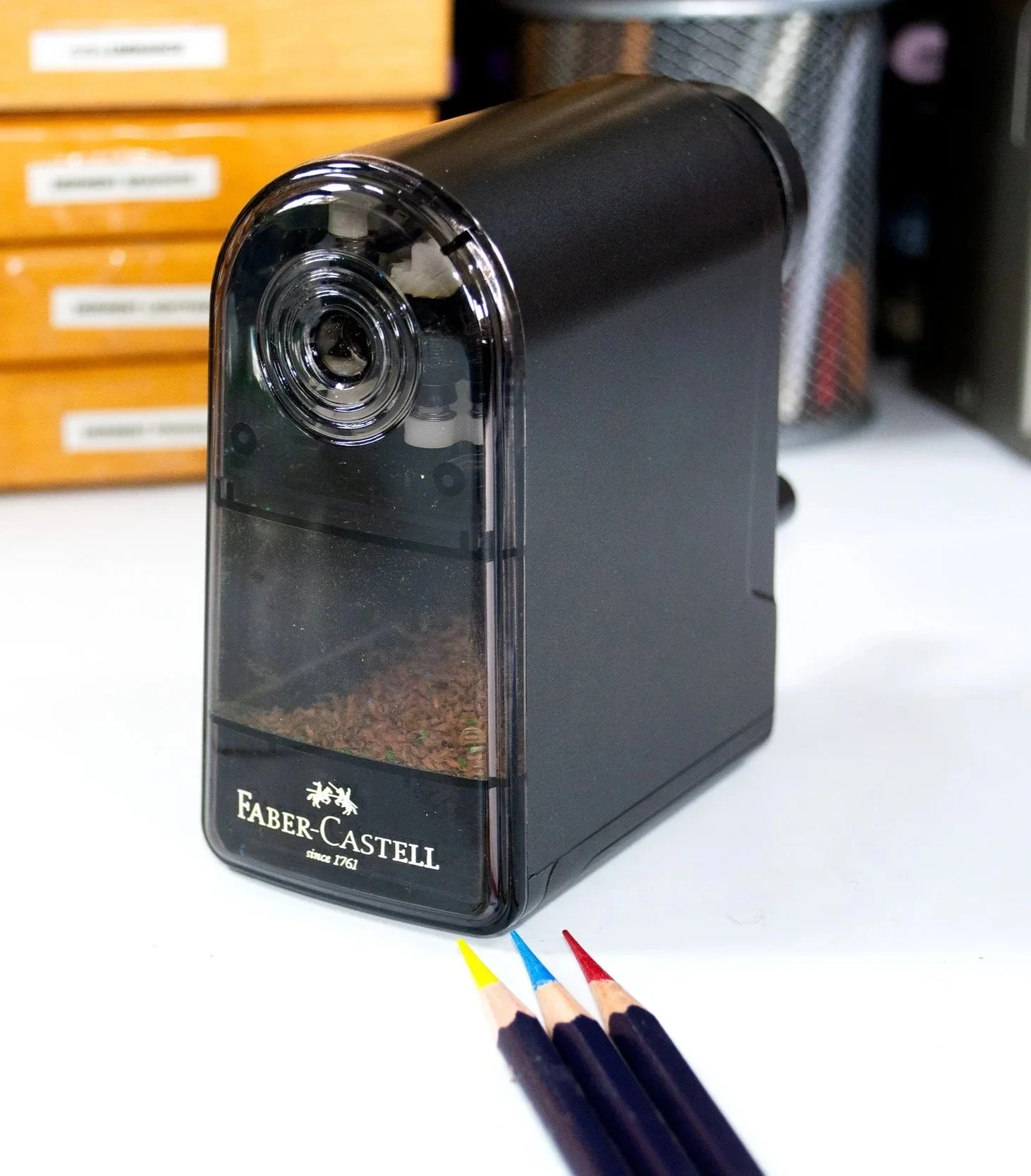
On the rear of the sharpener toward the base, there is a small square button, on pressing the button, the base plate of the sharpener opens via a spring loaded mechanism. This makes emptying the sharpener incredibly easy. So many other hand crank sharpeners require the artist to remove a small tray or drawer and empty into a bin. With the Faber Castell sharpener, all that is required is to hold the sharpener over a bin, press the button on the rear and it is empty of pencil shavings.
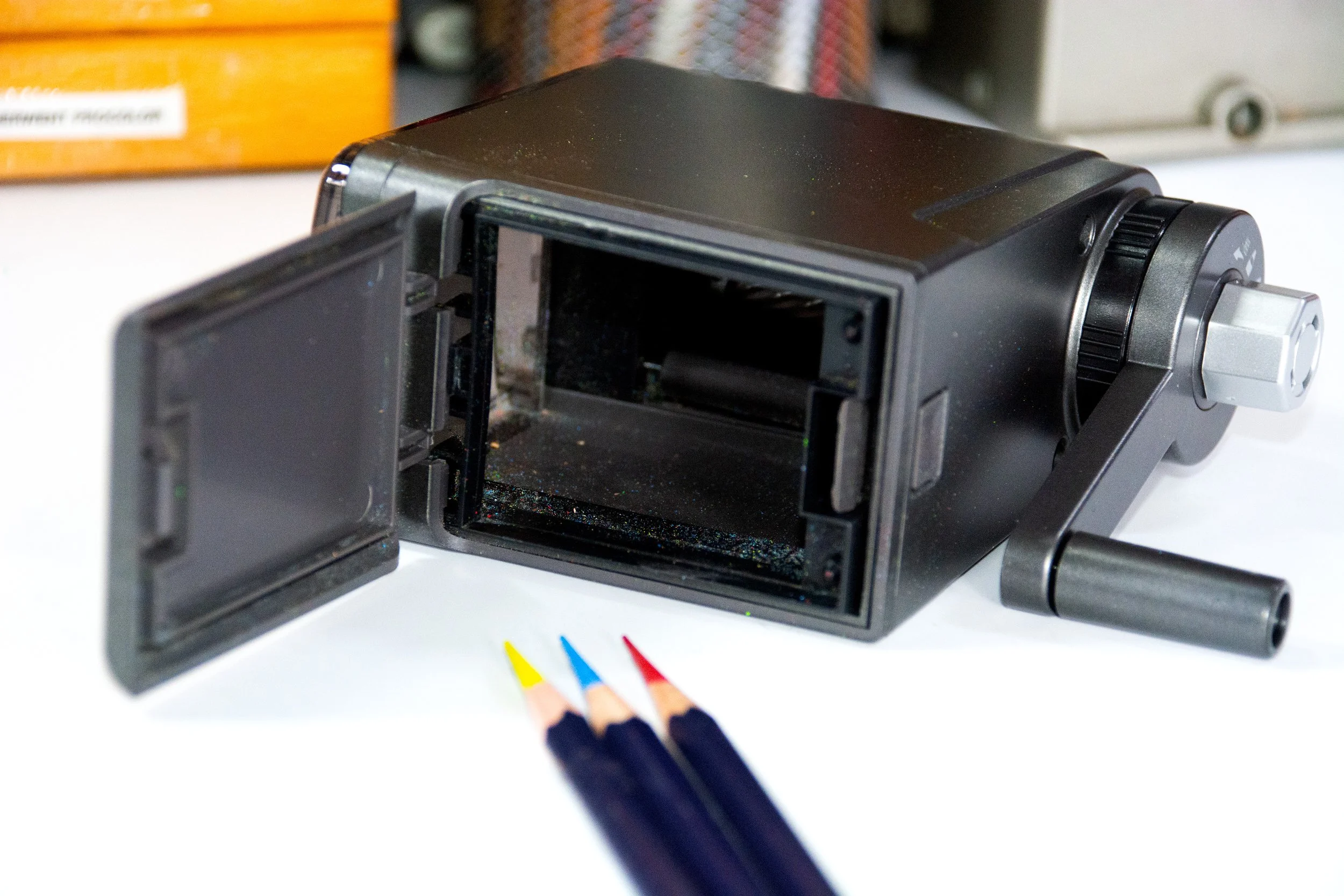
There is of course a small handle at the top of the sharpener which sports a dial, indicating the various settings available to the artist. If you view the dial, there is three icons, all of them depicting the sharpness setting, the first shows a blunt squared off core, the second shows a slightly sharper core, with the third icon depicting a sharp core.
However the dial is a little bit misleading, when I originally started to test the product, I turned the dial to point at the icons, however, after further investigation, I discovered there is actually 7 settings of various sharpness. As you will see in the performance section, there is not a hugely noticeable difference between the cores.
Where the handle is located, further in toward the actual sharpener, just past the dial, there is a black ridged ring and to remove the internal blade for cleaning of declogging, simply hold the internal band and twist anticlockwise. This will allow you to remove the blade for maintenance and the replacement is simply the reverse.
On the front of the Faber Castell Sharpener, you will have noticed that there is an absence of the two pins, normally used to open and close the teeth that trip hold of the pencil during sharpening. With the Faber Castell Sharpener, all you simply do is insert the pencil, fully into the slot and turn the handle. For some this may not appear as a huge deal, however, for those artists that suffer with arthritis in their hands, fingers or wrists, traditional hand crank sharpeners can be difficult and painful to use, with this sharpener, that issue is gone.
On the front of the sharpener, there is dark perspex allowing the artists to monitor if and when the sharpener needs emptying of pencil shavings. Along the very bottom of the perspex there is a Faber Castell logo
Faber Castell Hand Crank Sharpener Performance
For this demonstration I selected 3 Derwent Studio pencils, brand new pencils that had yet to be sharpened, I wanted all three pencils, regardless of brand to start from the same position. Unfortunately I didn’t have any completely unsharpened pencils, as this would have been a more preferable test, so making do with factory sharpened pencils was the next best thing.
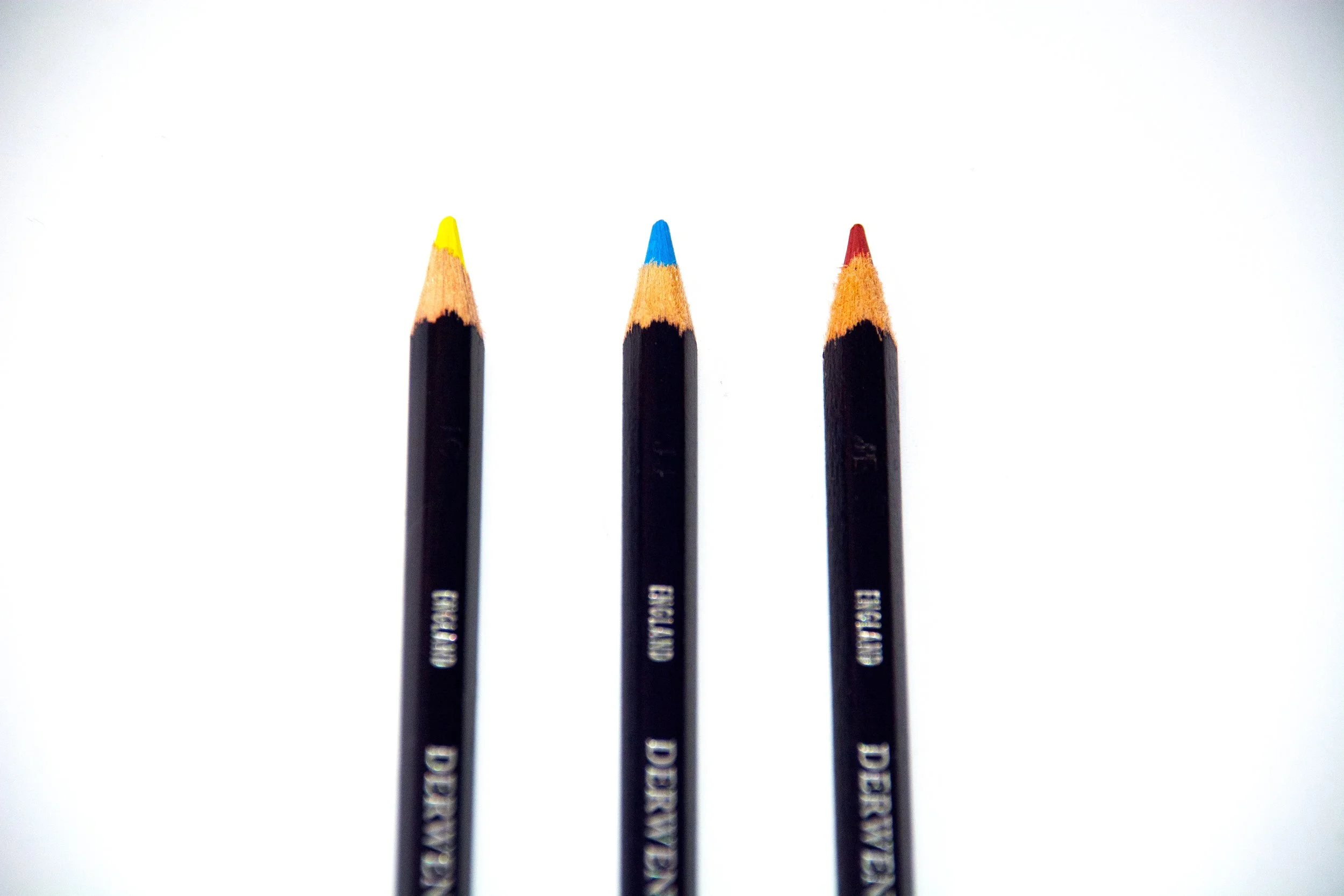
The first demonstration was on the dullest setting, I chose the red cored Derwent Studio pencil, inserted it into the Faber Castell sharpener and turned the handle. As soo as you start you will feel the blade starting to shave the pencil barrel and once the selected setting has been completed, the handle slackens loose, providing the artists with a clear indication to remove the pencil.
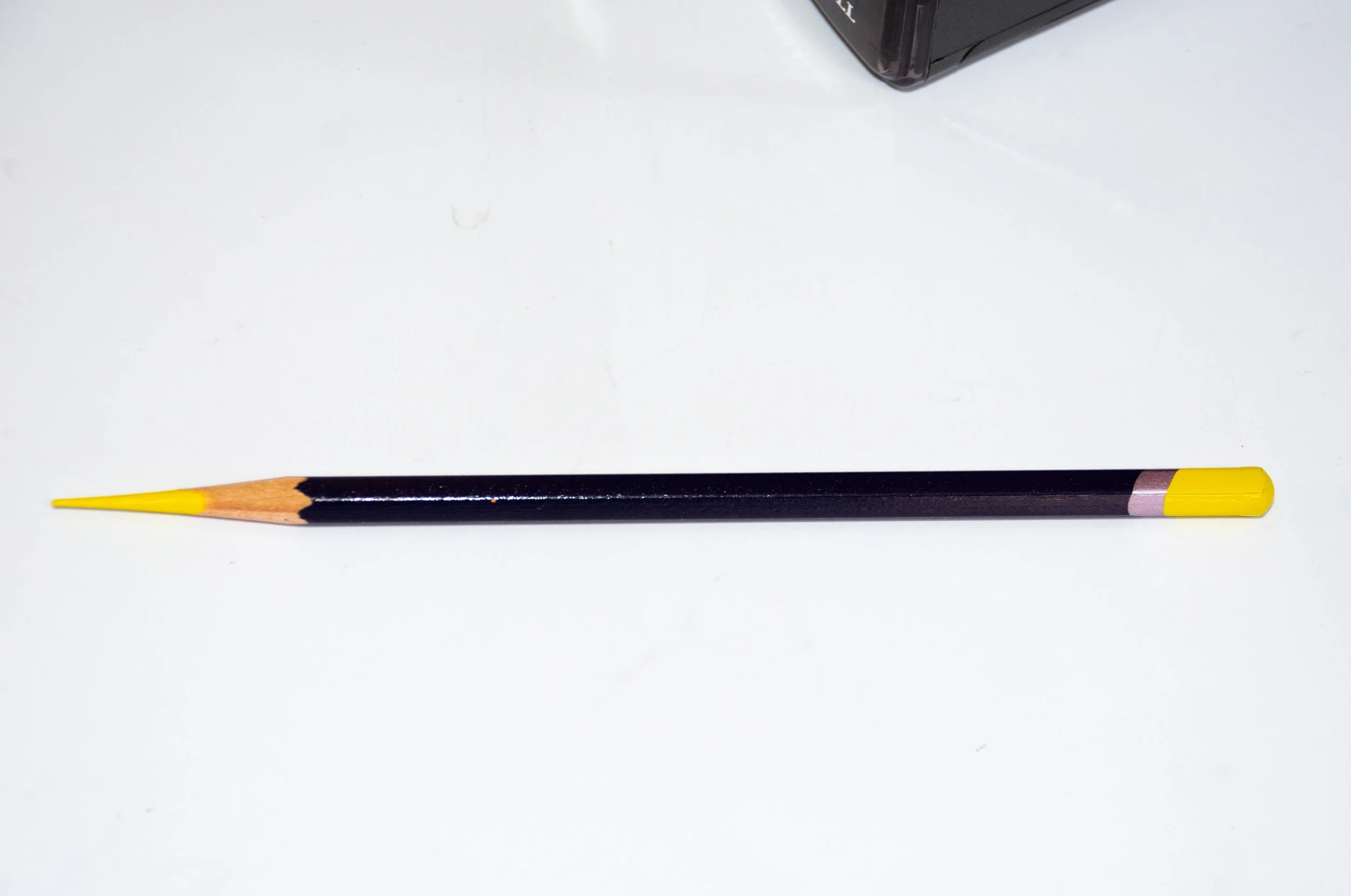
The second demonstration I selected the middle range on the dial, obviously with there being 7 settings, I couldn’t select 3.5 so the closest I could select to the middle was the 4th setting. For this demonstration I selected the yellow Derwent Studio pencil and turned the handle until the setting had finished. The result was very similar to the first demonstration of the red pencil, but if you look closely you can see a slight difference.
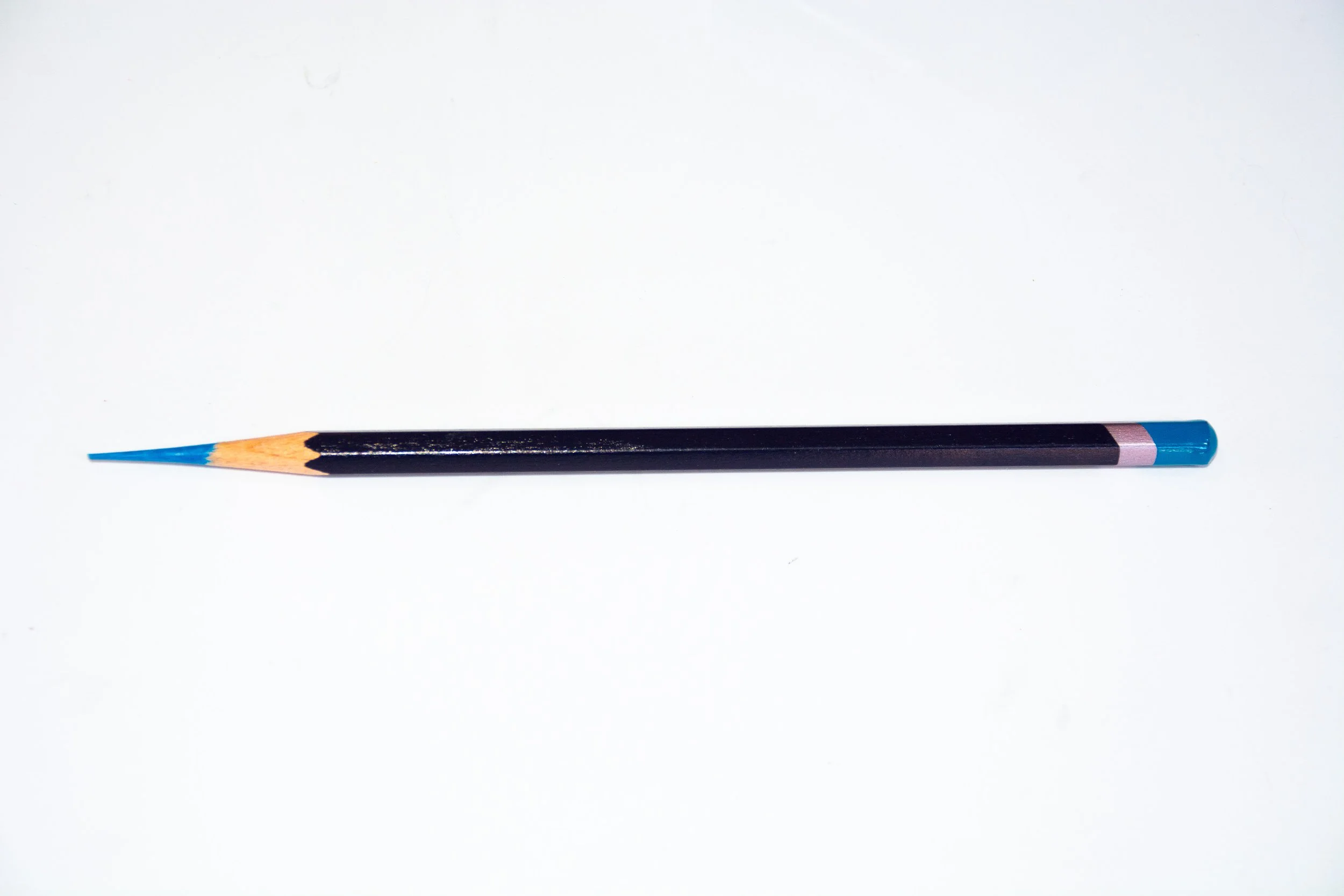
For the third demonstration, I selected a blue Derwent Studio pencil, inserted it into the Faber Castell sharpener and turned the handle until the setting was complete. For this third demonstration I selected the sharpest setting on the dial.
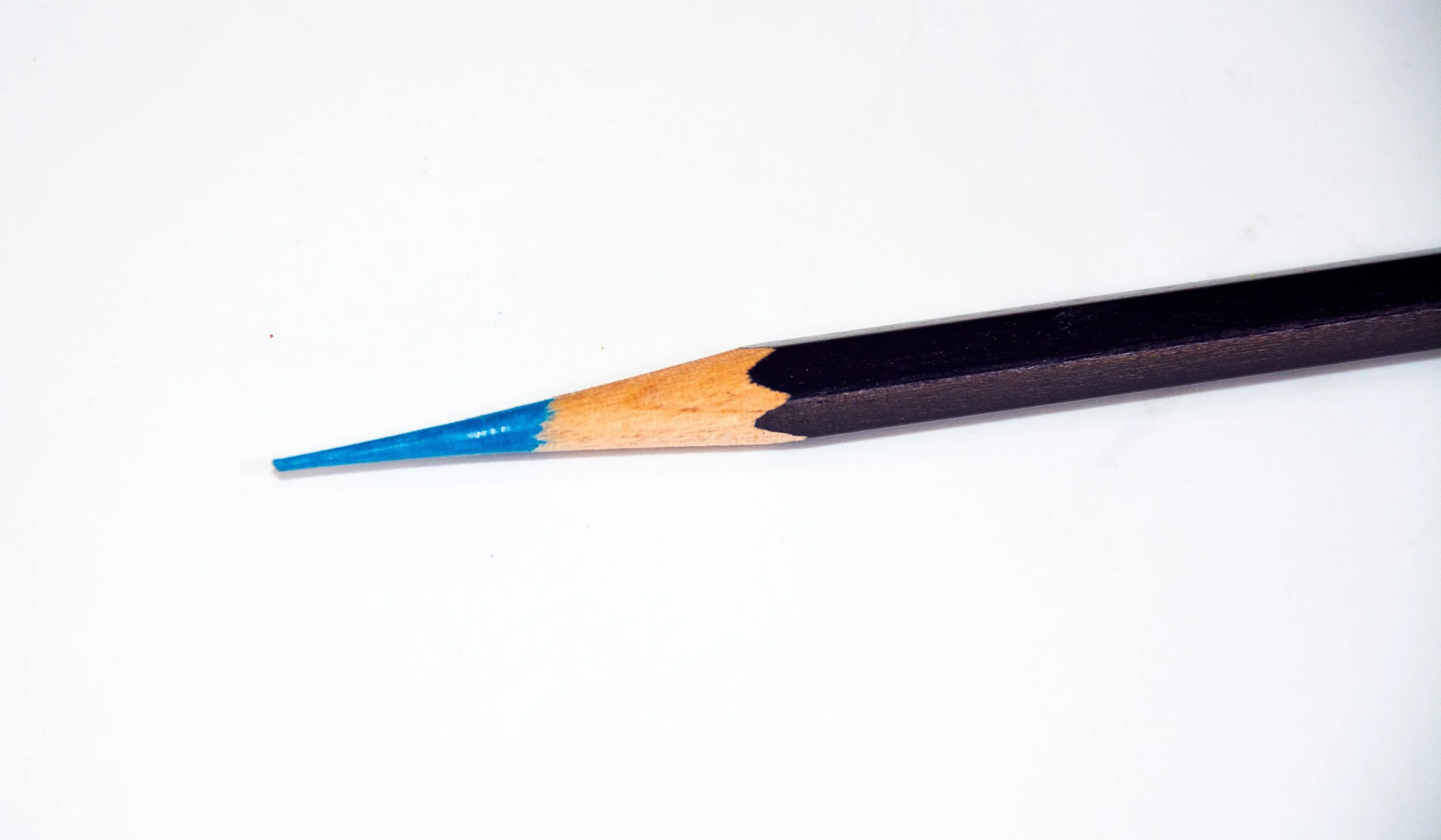
As you can see, all three pencils side by side, in order of dullest to the sharpest. You can see that the Faber Castell sharpener provides a long point on the core. For me personally, this is a style of sharpened pencil that I have never been able to work with, however I know there are a lot of artists who prefer this format.
Sporting a long pointed core, in a way, forces the artists hand to apply light layers when working, which is perfect for colored pencil or graphite artists who like to work in this way. For me personally, I think my issue with a long point is more a problem with me than the format, being slightly too heavy handed, I fear I would be snapping a wasting a lot of core.
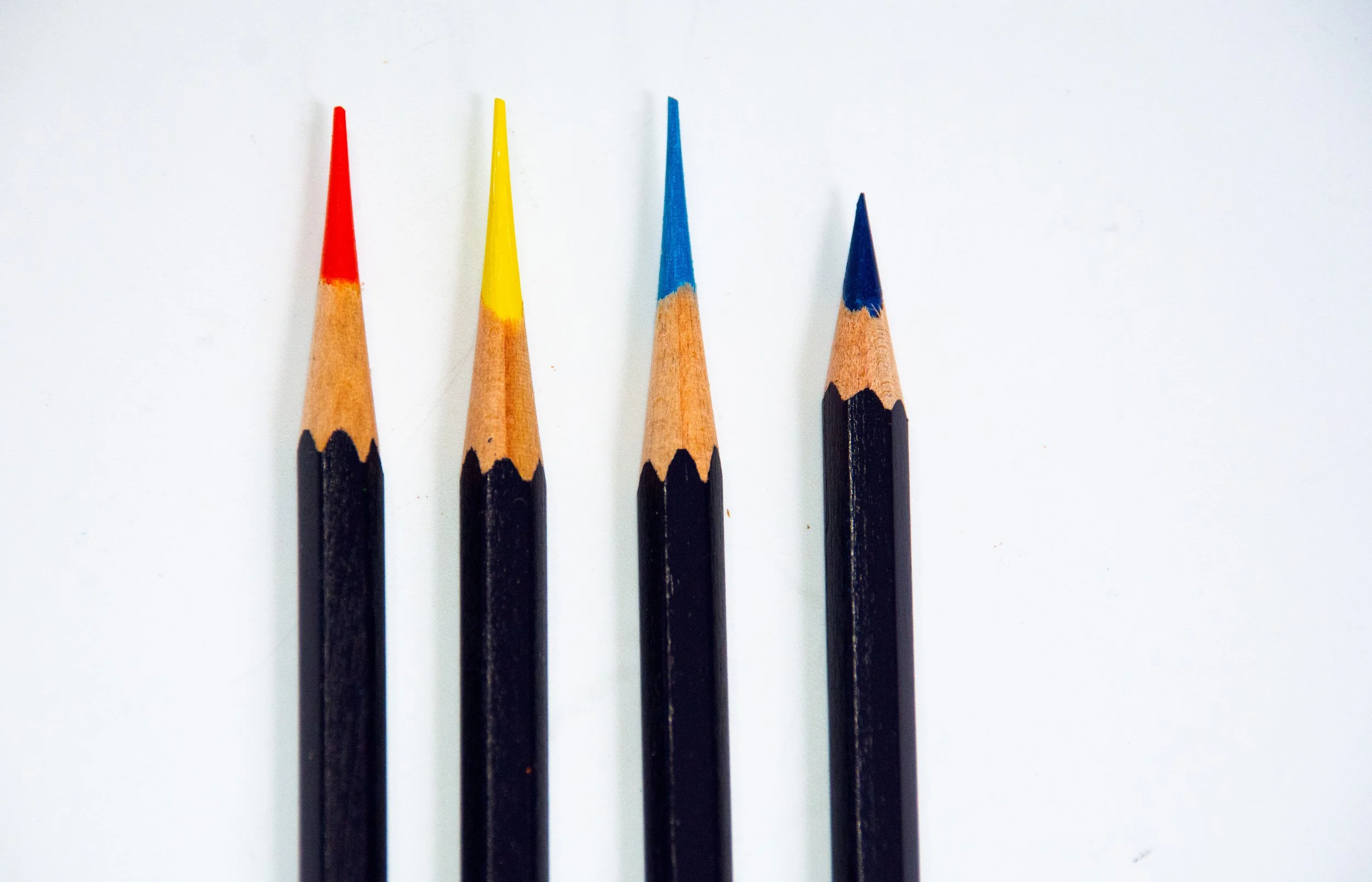
As you can see from this next demonstration, I used a small hand held M&R sharpener and you can clearly see that although the exposed core is much shorter that that of the Faber Castell Hand Crank sharpener, the very tip of the core is pin sharp. For a heavier handed artist such as m myself, I feel I waste less of the core if I apply too much pressure, but I also feel that the M&R style sharpened core, allows the artists to achieve more detail. Compared to the long cores of the Faber Castell hand crank sharpener, although the cores a long, the very tip of the core on them all appears to be more squared than that of the hand held sharpener.
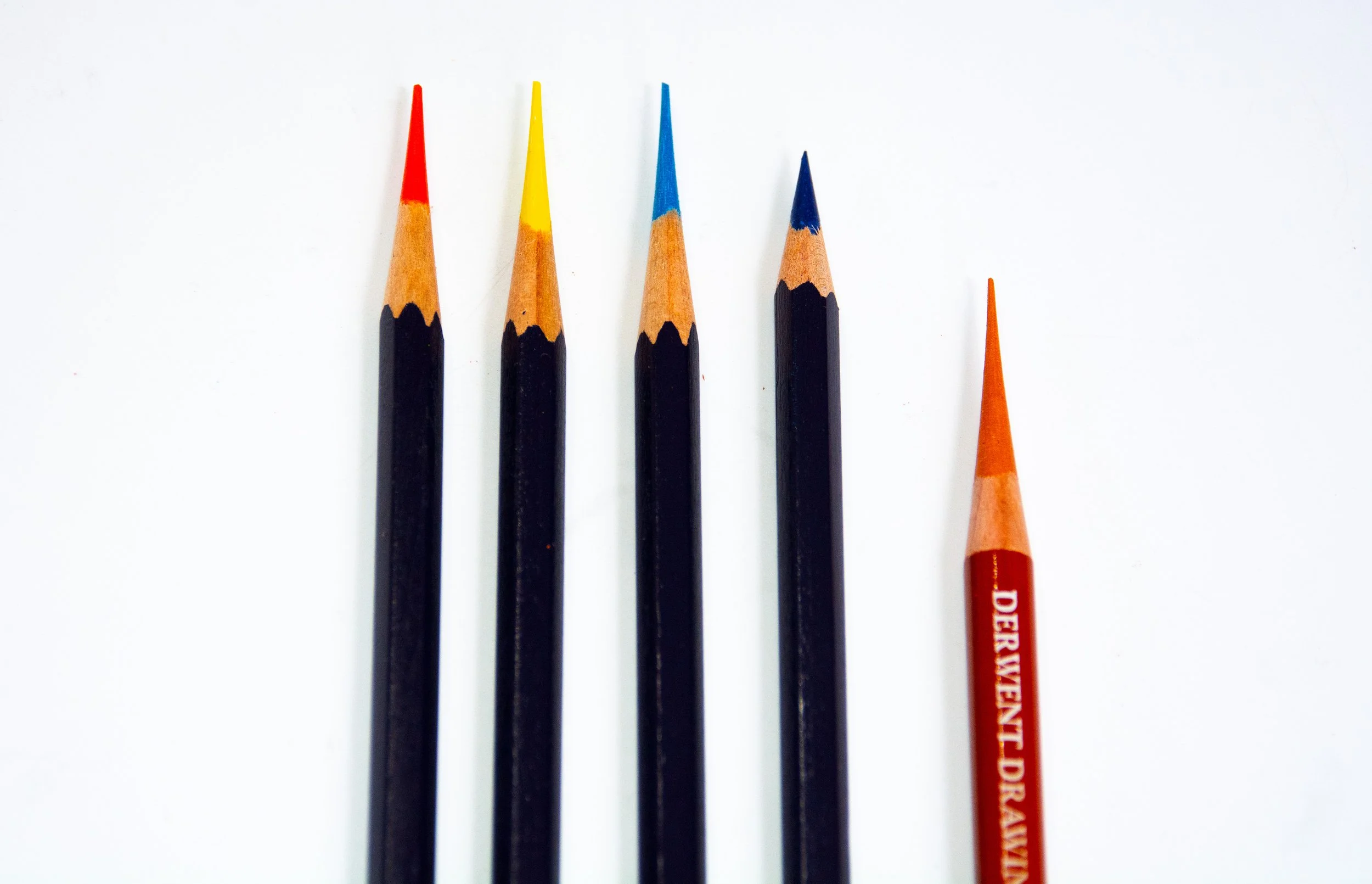
The Derwent Studio pencils are quite a slim barrelled pencil and so I wanted to test the larger diameter barrelled pencils such as the Derwent Drawing pencil. The Derwent Drawing pencil sports a much larger 8mm barrel as opposed to the Derwent Studio smaller 6.6mm barrel. As you can see from the results, the Derwent Drawing pencil worked perfectly well in the Faber Castell sharpener.
Faber Castell Hand Crank Sharpener Price
Given the quality of this Faber Castell Sharpener, I think you will find the price very reasonable especially if as a pencil artist you enjoy the long point format.
For artists in the UK you can expect to pay approximately £8.83 for this Faber Castell Sharpener
For artists in the US you can expect to pay approximately $11.48 for this Faber Castell Sharpener
For artists in the EU you can expect to pay approximately €10.07 for this Faber Castell Sharpener
Faber Castell Hand Crank Sharpener Conclusion
As I highlighted at the beginning of this review, I am unable to 100% that this is a legitimate Faber Castell product and the only thing that raised my eyebrows was when I went to the official Faber Castell website, there was no sign of the sharpener on their site. That being said, other than the cast iron stamp of Faber Castell quality and assurance, the product itself has many excellent qualities.
My favourite has to be the ease of inserting the pencil and sharpening it, artists with arthritis in their hands and wrists will find this sharpener very agreeable. The format of the sharpened results is purely down to personal preference, I personally can’t use a long core format anvd tend to waste a substantial amount of core, via my heavy handedness; but this is not to say the device is not creating a good sharp core.
The cost of the Faber Castell sharpener is also very reasonable which I have listed above. If you are interested, I have also provided a YouTube video review where you can watch me sharpen the pencils and see for yourself the sharpener working in real time. To view my YouTube video review click the link and it will take you directly to the review.